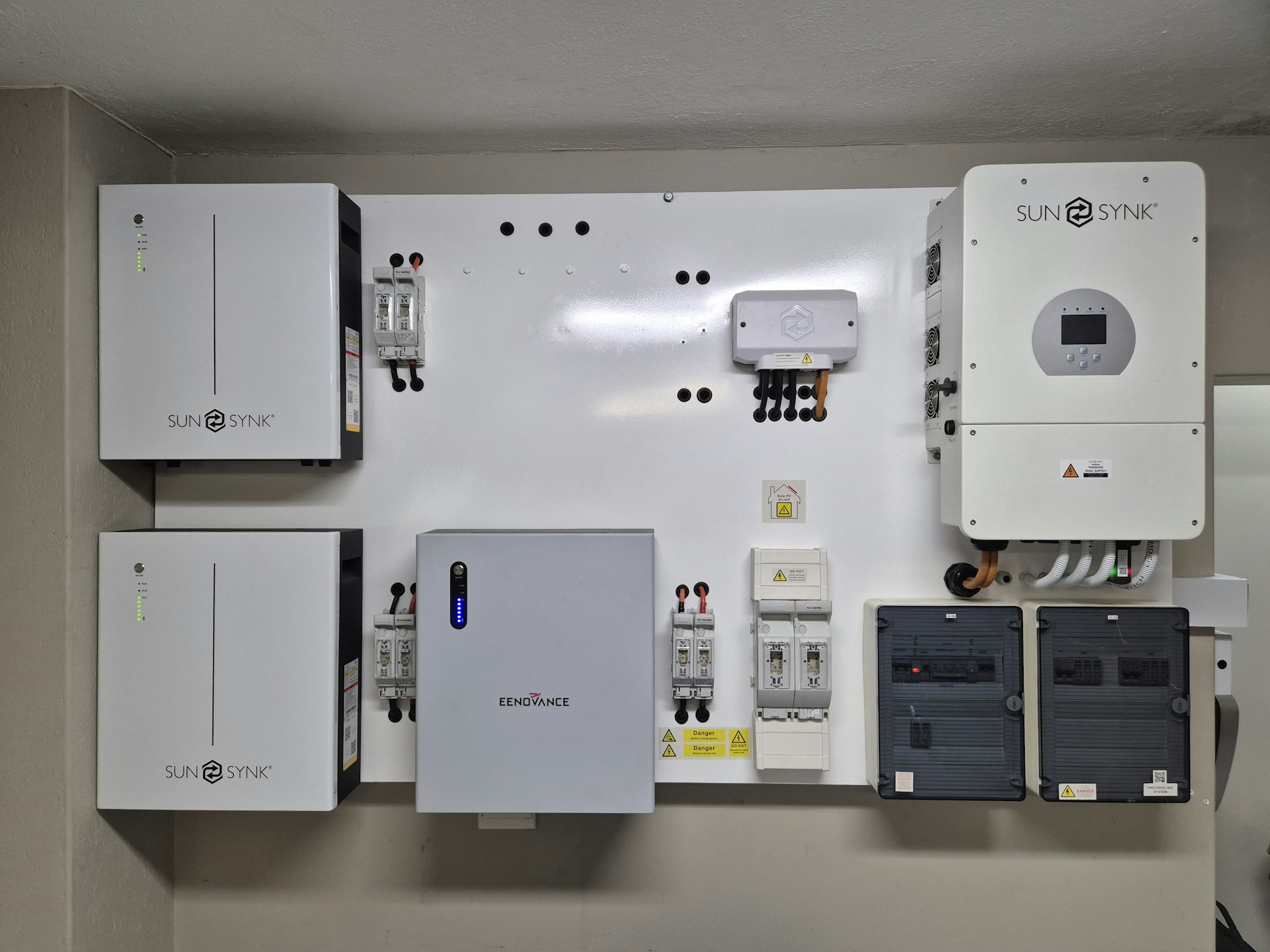
LiFePO4 vs NMC: why chemistry choice determines your battery lifespan is not a small detail. The catch is simple: the chemistry drives cycle life, heat behavior, and how hard the BMS has to work, so replacement timing usually comes down to the cathode you pick.
Key Takeaways
| Decision driver | LiFePO4 (LFP) tends to win | NMC tends to win | |---|---|---| | Cycle life for solar energy storage | Longer service life under many duty cycles | Higher energy density, smaller packs | | Thermal stability and abuse tolerance | Better thermal behavior, lower thermal runaway likelihood | Acceptable with tight management, not "forgiving" | | Aging at high temperatures | Calendar and cycling often hold up better | More sensitive to heat and SOC history | | Daily deep discharge behavior | More usable cycle life across real loads | Can last long with conservative SOC limits | | Compatibility and integration in 2026 | Straightforward setpoints for many systems | Integration works, but settings matter a lot |
- Cycle life: LFP usually stretches replacement timelines, NMC often needs more careful SOC and temperature control.
- Safety: chemistry choice shapes thermal runaway risk, which affects system lifespan indirectly (how often you hit protection events).
- BMS reality: Internal battery management systems monitor voltage, temperature, and current, and they can make or break lifespan.
- Solar energy use: Your duty cycle (deep daily discharge vs light cycling) matters as much as the cell.
- RV power: For rv power in hot conditions, chemistry and charging windows decide whether "years of service" stays true.
- Want a system-level lens: we recommend reading the practical guidance in LFP vs NMC for BESS: Which Cell Chemistry Fits Your Application? before you pick a pack.
Quick link for planning: if you are building around charge profiles, start with Polarium Energy Solutions & Morningstar (Technote) and match setpoints to your controller.
LFP vs NMC Chemistry Lifespan in 2026: What the Numbers Actually Say
Here is the field reality we keep running into. In 2026, battery makers still publish capacity and safety specs, but the lifespan outcome depends on cycle count plus how you operate the cells, especially temperature and depth of discharge.
LiFePO4 typically delivers long life under many "standard conditions" (think 25°C and conservative end-of-life definitions), while NMC often degrades faster when you push it hard or keep it at high SOC too long.
Did You Know? LFP typically delivers 3,000–6,000 cycles for standard-grade cells and 6,000–10,000+ cycles for premium-grade cells under standard conditions (25°C, 80–100% DOD, EOL at 80% SOH). Source: SunLithEnergy.com
Now compare that to NMC. Under comparable conditions, you typically see a much shorter cycle-life band, which is why "same usable capacity, different replacement schedule" shows up so often in solar energy storage and rv power setups.
- Common outcome: LFP stretches "battery replacement timing," NMC often pushes you toward earlier service intervals.
- Where you feel it: daily deep cycling, hot climates, and winter storage where self-discharge changes how you plan charge controller(s) runtime.
- Why chemistry choice matters: cathode composition affects how cells age, which controls the slope of capacity fade and impedance growth.
If you want a system-level checklist for BESS design, this guide is a good companion: LFP vs NMC Battery for Solar 2026: Safety, Cost & Lifespan Compared.
Depth of Discharge and SOC Limits: Where Lifespan Is Won or Lost
People argue about chemistry as if it is the whole story. It is not. You can get better lifespan from NMC by running conservative SOC windows, or you can make LFP age faster by abusing temperature and cycling at the extreme ends.
LFP depth-of-discharge guidance often looks generous because it tends to hold cycle life across high DOD use, whereas NMC frequently needs stricter operational limits. The BMS is the referee here, it keeps voltage, temperature, and current inside safe bounds, but your charging and inverter settings also matter.
In practical terms for outdoor solar and camping and backpacking solar, you will usually run one of two patterns:
- Pattern A, "daily draw": you drain batteries and recharge the next day (common for off-grid and rv power).
- Pattern B, "long idle": you store energy for days or weeks and then top up (common for seasonal cabins and off-season camping).
Pattern A punishes deep cycling at high temperature. Pattern B punishes high self-discharge and any habits that keep the battery at elevated SOC during storage.
Realistic assessment: in camping and backpacking solar setups, your charging controller(s) and your habits (SOC window, how long you sit at high charge, how hot the pack gets) decide whether "rated cycles" looks like real cycles.
Safety, Thermal Runaway, and Why Risk Changes Battery Lifespan
Safety is not only about avoiding catastrophic events. It also changes lifespan because trips into protection modes, high heat exposure, and abnormal charge situations can accelerate aging.
A charging system can be technically "compatible" and still cause longevity problems if it repeatedly runs the battery near its limits. NMC cells can be perfectly usable, but they are typically less forgiving in thermal abuse scenarios, while LFP shows stronger thermal resistance.
For a quick safety orientation tied to DIY solar guidance, you can read LFP vs NMC Battery Safety and then cross-check how your pack's BMS behaves during charge acceptance and temperature rise.
- Thermal behavior: LFP has a higher thermal-runaway threshold, NMC can enter thermal runaway at lower temperatures.
- System behavior: when heat rises, BMS current limits and voltage cutoffs protect the pack, but repeated stress still impacts wear.
- Outdoor solar reality: sun, wind, and enclosure design decide how hot the battery gets, not just what the datasheet says.
We also see a pattern in residential installs and off-grid builds: the "housing" and ventilation matter as much as chemistry because batteries do not live in a lab. They sit in enclosures, near inverters, and they soak up heat from the environment.
Solar Energy Storage: Choosing Chemistry for Stationary vs Mobile Duty Cycles
Let's separate stationary storage from mobile use because chemistry choices play out differently. In solar energy storage, batteries often see repeated day/night cycles with stable temperature control, so cycle life and calendar aging become your main lifespan drivers.
In mobile use (rv power), the pack experiences more temperature swings, more vibration, and more "imperfect" charge behavior when people rely on portable solar and quick upgrades.
That is where LFP often becomes the practical favorite. Not because NMC is "bad," but because LFP generally gives you more lifespan headroom with typical solar energy habits and outdoor solar conditions.
A simple decision framework (2026 style)
- Define your duty cycle: how many cycles per week, and how deep are you going?
- Lock your temperature plan: where will the battery sit, shade patterns, enclosure airflow, and sunlight exposure.
- Match charging setpoints to your chemistry: do not treat all lithium packs the same, use the correct charge voltage settings and BMS logic.
- Size your solar for your worst day: size your panel to your most power-hungry device, not your total gear list.
If you need a chemistry comparison specifically framed around solar storage, the guide from SurgePV is directly on point.
Outdoor Solar and RV Power: Why Real-World Heat and SOC History Matter
Here is the part that surprises people. Two batteries with the same chemistry can age very differently depending on shade patterns, enclosure temperature, and how long they sit near full charge.
We treat outdoor solar builds like a system contract. Your battery expects similar respect — it needs stable charging behavior and heat control, or it will quietly lose usable capacity.
For rv power and off-grid use, the chemistry choice affects what your system can tolerate:
- LFP: often holds up better when you accidentally cycle deeper than you planned or run in hotter weather.
- NMC: can be great when you manage SOC limits and temperature carefully, but repeated stress can accelerate capacity fade.
In 2026, many premium packs now ship with stronger BMS strategies, but the pack cannot fully cancel out bad system habits. It can only protect against the worst outcomes.
Integration and Charging Settings: Where Mistakes Commonly Steal Lifespan
You do not just "buy LFP or NMC." You integrate it. Charge voltage settings, cell counts, and controller behavior shape how the battery lives over time.
Morningstar's integration guidance for Polarium highlights that for 48V nominal battery banks, you need correct configuration, including charging settings and cell configuration (for example, LFP 15 cell versus NMC 13S or 14S). If you get the setpoints wrong, you can shorten lifespan even if the hardware is otherwise high quality.
Internal battery management systems (BMS) monitor voltage, temperature, and current. If your charge controller(s) and settings do not match the chemistry and configuration, the BMS does more work, and the battery ages faster.
So yes, chemistry determines the baseline. But integration determines the pace at which you reach end-of-life.
If you want the technical side for controller matching, use Polarium Energy Solutions & Morningstar (Technote) as a reference for how setting discipline should look.
Field Testing Reality: What Hot Climates Teach Us About LiFePO4 vs NMC Lifespan
One reason LFP keeps winning in "hot climate" conversations is that temperature stress makes aging more aggressive. In 2026, we keep seeing more region-specific guidance because the same chemistry does not behave identically across all environments.
A practical example is the "India Climate Battery Test" framing in Qbits Energy's comparison, where LFP wins for solar battery applications due to thermal stability, cycle life at elevated temperatures, and safer housing expectations in residential environments.
Another angle comes from research datasets and aging studies that emphasize the role of both calendar aging and cycling conditions. For example, NMC aging datasets track how capacity and impedance shift based on duty cycles, SOC history, and temperature.
Did You Know? NMC cells tested under comparable conditions typically deliver 1,000–3,000 cycles for standard-grade cells and 2,000–4,000 cycles for premium-grade cells. Source: SunLithEnergy.com
That cycle-life gap is exactly why choosing between LiFePO4 vs NMC often becomes a "replacement timing" decision for solar energy storage and rv power. If you cycle often or run hotter than planned, chemistry choice tends to dominate the timeline.
So Which Chemistry Should You Pick in 2026?
We usually recommend deciding based on how you will actually use the battery, not how you hope it will behave.
Choose LiFePO4 (LFP) when you care about lifespan headroom
- You plan daily cycling for outdoor solar, off-grid, or rv power (especially if you cannot always control temperature).
- You want better tolerance for deeper cycles and common real-life charging habits.
- You value safety margin and thermal robustness in outdoor environments.
- You want predictable replacement timing for solar energy storage over multiple seasons.
Choose NMC when you need higher energy density
- You need smaller or lighter packs and you can enforce strict charging and operating windows.
- Your system design is tight (controllers, BMS settings, temperature control, and correct integration).
- You plan conservative SOC limits to reduce aging pressure.
For a reference on chemistry choice for storage applications, use LFP vs NMC for BESS: Which Cell Chemistry Fits Your Application? as a structured comparison.
Also, if you are evaluating chemistry with an eye on real aging behavior, the public aging literature and datasets can help you understand what capacity fade and impedance growth can look like under different cycling and calendar conditions. Start with Comprehensive battery aging dataset: capacity and impedance fade measurements of a lithium-ion NMC/C-SiO cell.
Portable Solar Generator Deep-Dive: Chemistry at the Cell Level
The portable solar generator market adds another layer to the LiFePO4 vs NMC decision. Everything above applies — cycle life, thermal stability, and BMS behavior still dominate the lifespan conversation — but portable units introduce weight, usable capacity, and cold-weather performance as deciding factors that stationary storage rarely has to worry about.
What's actually different between the two at the cell level?
Both are lithium-ion chemistries, but the cathode material differs, and that difference drives everything else. LiFePO4 (LFP) uses an iron-phosphate cathode with an olivine crystal structure that holds onto its oxygen tightly. NMC (nickel manganese cobalt oxide) uses a layered oxide cathode that releases oxygen more readily under stress. That single structural difference is the root cause of the cycle life gap, the thermal runaway gap, and part of the weight gap. Nothing here is proprietary to any manufacturer — it's basic electrochemistry, and it shows up identically whether the cell ends up in a $200 power bank or a $3,000 whole-home backup unit.
How much longer does LiFePO4 actually last in a portable unit?
Cycle life is measured to a defined endpoint — typically the number of full charge/discharge cycles before capacity falls to 80% of its original rating. Consumer-grade LFP cells in portable power stations are commonly rated 3,000 to 6,000 cycles to that 80% threshold; some premium cells claim higher. Consumer-grade NMC cells in the same product category are typically rated 500 to 1,500 cycles to the same threshold — industrial and EV-grade NMC cells can do better (1,500–3,000), but that's not usually what ships in a $300–$1,500 portable power station.
Translated into years: cycling a 4,000-cycle LFP unit once a day gets you past 10 years before it drops to 80% capacity. Cycling a 1,000-cycle NMC unit at the same daily rate gets you under 3 years. If you're running a portable generator daily off solar rather than as an occasional backup, this single number should carry more weight than price per watt-hour.
Is NMC's thermal runaway risk actually significant in a portable unit?
The onset temperature gap is real and well-documented: LFP cells begin thermal runaway around 270°C; NMC cells trigger meaningfully lower, in the 150–210°C range depending on nickel content, with higher-nickel formulations failing at the low end of that range. NMC cells also release more oxygen and burn hotter once runaway starts (peak temperatures near 800°C versus roughly 620°C for LFP), and eject a larger fraction of cell mass during failure.
Whether that matters for you depends on use pattern, not just chemistry. A well-designed BMS in either chemistry is built to prevent cells from ever reaching those onset temperatures during normal use — overcharge protection, cell balancing, and thermal cutoffs are the actual first line of defense, and a poorly implemented BMS can undermine even LFP's wider safety margin. The honest framing: LFP gives you a bigger margin for error if something in the protection circuitry fails; it doesn't mean NMC units are unsafe when used within spec.
What does "usable capacity" mean, and why isn't it the number on the box?
This is the dimension most comparison articles skip entirely. The Wh rating printed on a unit is the rated (nameplate) capacity of the cells, not necessarily what you can actually draw before the BMS cuts you off. The gap between the two is chemistry-driven, not just a marketing choice.
LFP has a very flat voltage-discharge curve — most of its capacity sits on a plateau where voltage barely moves — which lets a BMS safely use close to the full rated capacity, often 95–100% of nameplate, without materially accelerating degradation, because deep discharge doesn't stress the cell the way it does other chemistries. NMC's voltage curve sags more steeply near both ends of charge, and deep discharge is harder on the cell chemically, so manufacturers commonly build in a reserved buffer — cutting off charging around 90–95% and discharge around 5–10% remaining — to protect cycle life and cell health. That reserved margin means a portable power station's actual usable capacity can run 10–20% below its printed rating on an NMC unit, a gap that's smaller and less consequential on a comparable LFP unit. When you're comparing two units with the same advertised Wh figure, ask what percentage of that is actually usable — the answer is rarely identical between chemistries.
How much heavier is LiFePO4 for the same capacity?
At the cell level, LFP's energy density runs roughly 90–160 Wh/kg; NMC runs roughly 150–220+ Wh/kg. That means, gram for gram of cell material, NMC stores meaningfully more energy — LFP cells need somewhere between about 40% and 90% more mass to store the same watt-hours, depending on which cells you're comparing.
Two caveats keep this from translating directly into "the finished product weighs 50% more." First, a portable power station's total weight includes the enclosure, inverter, charge controller, and BMS — components that don't change with chemistry — so the cell-level density gap gets diluted once you weigh the whole unit rather than just the battery pack. Second, published Wh/kg ranges vary by cell manufacturer and format, so two "LiFePO4" units from different brands can differ from each other by a meaningful margin before you even get to the NMC comparison. Treat "LFP units are heavier" as directionally true and worth checking on the spec sheet, not as a fixed multiplier you can apply to any two products.
How do the two chemistries handle cold weather?
Two separate questions get conflated here, and the answers point in different directions.
Charging in freezing temperatures is a lithium-ion problem, not an LFP-specific one. Charging any lithium-ion cell — LFP or NMC — below roughly 0°C (32°F) risks lithium plating on the anode, a mostly irreversible process that permanently reduces capacity and can create internal short-circuit risk over time. Quality BMS implementations in both chemistries disable or throttle charging below that threshold; a handful of premium units add self-heating elements to warm the pack before allowing a charge. If a comparison claims LFP alone has this limitation, that's incomplete — check whether the unit you're evaluating has low-temperature charge cutoff regardless of chemistry.
Discharging in the cold is where the two chemistries actually diverge, and counter to the usual "LFP wins everything" narrative, NMC has a modest edge here. At around -20°C, LFP cells typically retain roughly 60–70% of rated capacity, while comparable NMC cells retain closer to 70–80% — a real but not dramatic 5–10 percentage point gap in NMC's favor. For most portable solar generator use — an RV, a cabin, a winter power outage — that gap is unlikely to be the deciding factor on its own, but it's worth knowing before assuming LFP is strictly better in every dimension.
Conclusion
LiFePO4 vs NMC: Why chemistry choice determines your battery lifespan comes down to how the cathode ages under your operating pattern. In 2026, LFP generally offers longer cycle life and stronger thermal stability, so it tends to win when your solar energy storage or rv power setup runs hotter, cycles deeper, or lives in less controlled outdoor conditions.
NMC can still be a solid choice when you need higher energy density and you enforce conservative SOC limits with correct integration. No, you cannot "set it and forget it" with any chemistry — internal battery management systems help, but chemistry plus charge settings plus temperature history decide whether your battery hits the years you budgeted for or surprises you with earlier replacement.
Frequently Asked Questions
Is LiFePO4 better than NMC for solar energy storage in 2026?
For most solar energy storage use cases in 2026, LiFePO4 is the safer bet when you care about longevity, because chemistry choice usually translates into longer cycle life and better thermal stability. NMC can work well too, but you typically need stricter SOC and temperature control to protect lifespan.
How many cycles do LiFePO4 and NMC batteries typically last?
The LiFePO4 vs NMC lifespan gap shows up in cycle counts under comparable test assumptions, where LFP often ranges into the multi-thousand cycle band and premium tiers reach higher. NMC cells commonly test lower in cycle life unless you manage operating conditions carefully.
Does depth of discharge matter more than chemistry for battery lifespan?
Depth of discharge matters a lot, sometimes as much as the cathode chemistry in practice. With LiFePO4 vs NMC, NMC is often more sensitive to aggressive cycling and high SOC time, so operating limits can swing real lifespan outcomes.
Which chemistry is safer for outdoor solar and camping and backpacking solar?
In outdoor solar conditions, LiFePO4 generally offers a stronger thermal safety margin, which matters because batteries get hotter than people expect. That chemistry advantage helps protect lifespan by reducing harsh stress events, even when your field setup is imperfect.
Is NMC worth it for rv power if I want lighter batteries?
NMC can be worth it for rv power when energy density and weight are top priorities and your system design is disciplined. If you cannot reliably control charge profiles, temperature, and SOC limits, LiFePO4 usually delivers better lifespan consistency.
What should I check before buying a battery based on LiFePO4 vs NMC?
Check integration details first — cell configuration, and the correct charge voltage settings for your controller — because chemistry choice only helps if the system matches. Then verify your BMS protections, temperature behavior, and whether the pack is designed for your outdoor solar duty cycle.