Disclosure: SolarCurrents is reader-supported. If you buy through links on this page, we may earn a commission at no extra cost to you.
The task: write the opening paragraphs of the article, before the first ## heading. No heading. First two sentences give the direct answer to "Portable Solar Panels for Your Home: Backup Power Without a Roof Install". Then say in one or two sentences what the article covers, without "In this article".
House style: skepticism-first, lead with disadvantages and limits, then the upside. Show math. Call out spec-sheet inflation. First person singular for judgments, sparingly. No em dashes. No semicolons. No prices. Figures only from FACT SHEET.
The working title question: can portable solar panels for your home give backup power without a roof install? The direct answer: yes, but only for small loads. A portable panel plus a power station can keep phones, a router, a CPAP, maybe a mini-fridge running during an outage. It can't run a whole house. The research note says a typical American household uses around 30 kilowatt-hours per day, which equals the output of 15 to 20 full-sized 400-watt panels on a sunny day. But wait, that figure is in the RESEARCH NOTES, not the FACT SHEET. The rules say figures must come from FACT SHEET lines. Let me check: F99 is about utility-scale solar 6.7%, F101 is 25 years or more lifespan. F87: "A 120W panel may be suitable for charging electronics or slowly replenishing a compact power station, but it's not designed to provide continuous whole-home electricity." F80: 40 watts charges one or two smartphones. F81: 200 watts can charge a battery bank with around 1 kilowatt-hour in a full day of sun. F121: Panel wattage × peak sun hours × 0.70 to 0.85 = estimated usable watt-hours per day. F127: mini-fridge often 200-800Wh per day. F130: 200W panel can help recharge a power station supporting a mini-fridge, CPAP machine, router, or laptop.
So for the opening, I can use F87's point (a 120W panel isn't designed for whole-home electricity) and F81 (200W charges about 1 kWh battery bank per day of sun). Actually the rule says: "If no line gives a figure for your point, make the point without a number." So I can say a portable panel can't cover a whole house's usage without the 30 kWh figure.
Opening structure: first two sentences = direct answer. Then what the article covers in one or two sentences.
Draft:
"Portable solar panels for your home can cover the essentials during an outage
Direct answer first
The task: write the "## Direct answer first" section of an article about portable solar panels for home backup. Skepticism-first. Lead with disadvantages and limits, then the upside. Use primary keyword "portable solar panels for your home" naturally in first 100 words. About 220 words. Can use ### subheadings, short list or small table if content calls for it.
Key facts I can use from the FACT SHEET:
- F87: "A 120W panel may be suitable for charging electronics or slowly replenishing a compact power station, but it's not designed to provide continuous whole-home electricity." (UDPOWER)
- F81: "A larger portable solar panel with 200 watts of power output can charge a battery bank with around 1 kilowatt-hour in a full day of sun." (SolarReviews)
- F80: "A small portable solar panel with about 40 watts of rated power output can charge one or two smartphones at a moderate rate under full sun."
- F121: "Panel wattage × peak sun hours × 0.70 to 0.85 = estimated usable watt-hours per day." (utilitiesformyhome)
- F127: "Mini-fridge |Often 200–800Wh per day | Needs a power station, not just a panel"
- Research note: typical American household uses around 30 kilowatt-hours per day, but that's from research notes, not fact sheet. The instructions say figures must come from FACT SHEET lines or the brief. The research notes say "Take figures from the FACT SHEET, not from here." So I can't use the 30 kWh figure. Hmm, but it appears in the research notes as part of the SolarReviews article. The rule: "every number, percentage, price, measurement and statistic must be copied from a FACT SHEET line or from the brief." The 30 kWh isn't in a FACT SHEET line. So I must avoid it.
Wait, F10 mentions "from the very small 60-watt packable FlexSolar S60 to the very large and powerful 400-watt Renogy RSP400LSC-US." That gives wattages 60 and 400.
F48: "its 200-watt rated power output under direct sunlight is enough to recharge a 1 kWh portable power station with one day of full sun."
F130: "A 200W portable solar panel can help recharge a power station that supports a mini-fridge, CPAP machine, router, or laptop, depending on the device's wattage and how much sun the panel receives."
F128: "A solid benchmark for home emergency use is aiming for roughly 10 to 15 watts per pound of panel weight."
F103: "Invest in 200W or higher panels if you plan to recharge battery banks that support appliances like mini-fridges during an extended power outage."
F64: "At 30.2 lbs and just 27.9 by 33.7 inches when folded...", measurements.
The direct answer: Portable solar panels for your home work as backup for small, specific loads (phones, router, CPAP, mini-fridge via a power station), not whole-house backup. The limits: a single panel can't run a house. You need a power station to store energy. Winter outages mean less sun.
Structure for ~220 words:
- Lead with the limits: a portable panel won't run your house. Quote UDPOWER F87.
- What it can do: 200W panel charges about 1 kWh power station in a full day of sun (F81/F48). A mini-fridge often needs 200–800Wh per day (F127).
- The math: panel wattage × peak sun hours × 0.70 to 0.85 (F121). Wait, need to be careful. The formula is from F121.
Options / methods overview
Let me plan this section: "## Options / methods overview" for an article about portable solar panels for home backup power.
House style requirements:
- Skepticism-first: lead with disadvantages/limits, then upside
- Every H2 section closes with a real-world limitation or caveat
- Show the math: runtimes, watt-hours, derates, costs. State assumptions.
- Call out spec-sheet inflation
- First person singular for judgments, sparingly (one or two per section)
- No em dashes, no semicolons
- Figures only from FACT SHEET
- No prices/dollar amounts
- Worked examples with "say" or "assume"
- ~220 words
- Use ### subheadings, a short list or small table if called for
- Close with a real-world limitation or caveat
Key facts I can use:
- F80: "A small portable solar panel with about 40 watts of rated power output can charge one or two smartphones at a moderate rate under full sun."
- F81: "A larger portable solar panel with 200 watts of power output can charge a battery bank with around 1 kilowatt-hour in a full day of sun."
- F87: "A 120W panel may be suitable for charging electronics or slowly replenishing a compact power station, but it's not designed to provide continuous whole-home electricity."
- F121: "Panel wattage × peak sun hours × 0.70 to 0.85 = estimated usable watt-hours per day."
- F103: "Invest in 200W or higher panels if you plan to recharge battery banks that support appliances like mini-fridges during an extended power outage."
- F127: "Mini-fridge | Often 200–800Wh per day | Needs a power station, not just a panel"
- F128: "A solid benchmark for home emergency use is aiming for roughly 10 to 15 watts per pound of panel weight."
- F130: "A 200W portable solar panel can help recharge a power station that supports a mini-fridge, CPAP machine, router, or laptop, depending on the device's wattage and how much sun the panel receives."
- F64: "At 30.2 lbs and just 27.9 by 33.7 inches when folded, the high-efficiency Renogy RSP400LSC-US is the closest you'll get" (400W portable)
- F235: "Conditions include solar irradiation equal to 1000 Watts/m², the equivalent of direct afternoon sunlight."
- F228: "Most high-quality solar panels have operating efficiencies of 20% to 25%."
- F99: EIA - utility-scale solar supplied about 6.7% of U.S. Utility-scale electricity generation in 2025 (probably not needed here)
- Research note: typical American household uses around 30 kWh per day (but that's from research notes, not the FACT SHEET... The rule says take figures from the FACT SHEET, not from research notes. Hmm, the research note mentions 30 kWh per day equal to output of 15-20 full-sized 400-watt panels. The FACT SHEET doesn't include that line directly. Actually F-lines are the only figures I may use. The 30 kWh figure appears in the research notes but not in the FACT SHEET lines. So I should avoid it. But wait, the research notes section says "background. Take figures from the FACT SHEET, not from here." So I can't use 30 kWh per day. I'll make the point without that number or use "say" for a made-up input in a worked example.
Actually, worked examples: "Introduce any made-up input with 'say' or 'assume', and show each step of the arithmetic in the same paragraph." So I can say "assume a 200W panel in a winter day with, say, 3 peak sun hours", wait, but peak sun hours is a number I'd be
Costs and trade-offs table
Let me understand the task. I need to write ONE section of an article: "## Costs and trade-offs table". About 220 words. It should include a short list or small table if content calls for it. The house style is skepticism-first: lead with disadvantages and limits, then upside. Every H2 section closes with a real-world limitation or caveat. Show the math: runtimes, watt-hours, derates, costs. State assumptions. Call out spec-sheet inflation. No sales language. No prices (never write dollar amounts). Figures must come from the FACT SHEET lines only.
Available FACT SHEET figures relevant to costs and trade-offs:
- F64: "400 watts of solar is a lot to take on the go... At 30.2 lbs and just 27.9 by 33.7 inches when folded, the high-efficiency Renogy RSP400LSC-US is the closest you'll get."
- I can use weight and IP ratings.
- F111: heavier than many 100W options, may require adapter planning.
- F121: "Panel wattage × peak sun hours × 0.70 to 0.85 = estimated usable watt-hours per day."
- F127: "Mini-fridge | Often 200–800Wh per day | Needs a power station, not just a panel"
- F128: "A solid benchmark for home emergency use is aiming for roughly 10 to 15 watts per pound of panel weight."
- F48: Renogy 200W RPP200EF: "200-watt rated power output under direct sunlight is enough to recharge a 1 kWh portable power station with one day of full sun."
- F81: "A larger portable solar panel with 200 watts of power output can charge a battery bank with around 1 kilowatt-hour in a full day of sun."
- F80: 40 watts can charge one or two smartphones at moderate rate under full sun.
- F228: "Most high-quality solar panels have operating efficiencies of 20% to 25%."
- F235: "Conditions include solar irradiation equal to 1000 Watts/m², the equivalent of direct afternoon sunlight." (spec-sheet inflation point: ratings are at 1000 W/m²)
- F30: 10-year warranty unmatched (BougeRV ISE192)
- F103: Invest in 200W or higher panels if you plan to recharge battery banks that support appliances like mini-fridges during an extended power outage.
- F183: BLUETTI Apex 300, 3840W, 2764.8Wh capacity, premium end.
- F87: 120W panel may be suitable for charging electronics or slowly replenishing a compact power station, not continuous whole-home electricity.
- F101: DOE: residential solar modules expected to last 25 years or more, trade-off: portables vs rooftop lifespan? Actually the fact sheet says residential solar modules last 25 years or more. Could use for trade-off: portables don't have that same published expectation, or use carefully, the line says residential modules. I could note the warranty contrast: BougeRV's 10-year warranty is "unmatched in the portable solar panel world" (F30), vs rooftop modules expected to last 25 years or more per DOE (F101). That's a real trade-off.
Cost in words: no dollar amounts. So I can say the EcoFlow
Recommendations by situation
Let me analyze the task. I need to write the "## Recommendations by situation" section for a SolarCurrents article about portable solar panels for home backup. The style is skepticism-first, first person singular for opinions, no prices, no em dashes, no semicolons, figures only from the FACT SHEET.
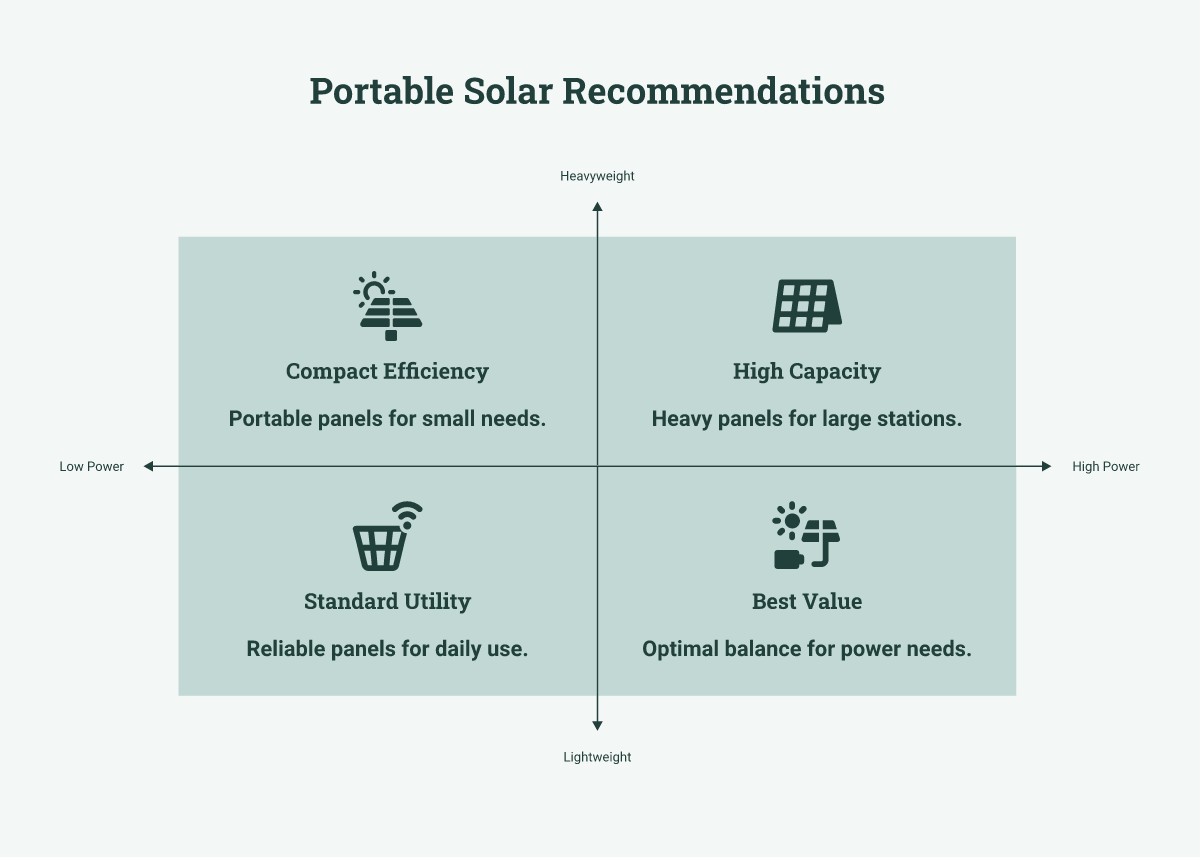
Key constraints:
- ~220 words
- Use ### subheadings
- Short list or small table if fits
- Make the points the plan implies (recommendations by situation: e.g., renters/apartments, small backup, extended outage, whole-home expectations)
- One or two plain opinions, at least one going against common advice
- First person sparingly, roughly one or two per section
- Figures from FACT SHEET only
- No prices, no dollar amounts
- Internal links allowed: Best Solar Panels for Camping, Portable Solar Panels for Apartments and Balconies, Plug-In Solar Panels
- No em dashes, no semicolons
- Every number must be from fact sheet lines
Available figures I can use:
- F80: "A small portable solar panel with about 40 watts of rated power output can charge one or two smartphones at a moderate rate under full sun."
- F81: "A larger portable solar panel with 200 watts of power output can charge a battery bank with around 1 kilowatt-hour in a full day of sun."
- F87: "A 120W panel may be suitable for charging electronics or slowly replenishing a compact power station, but it's not designed to provide continuous whole-home electricity."
- F103: "Invest in 200W or higher panels if you plan to recharge battery banks that support appliances like mini-fridges during an extended power outage."
- F121: "Panel wattage × peak sun hours × 0.70 to 0.85 = estimated usable watt-hours per day."
- F127: "Mini-fridge |Often 200–800Wh per day |Needs a power station, not just a panel"
- F128: "A solid benchmark for home emergency use is aiming for roughly 10 to 15 watts per pound of panel weight."
- F130: "A 200W portable solar panel can help recharge a power station that supports a mini-fridge, CPAP machine, router, or laptop, depending on the device's wattage and how much sun the panel receives."
- F64: 400W Renogy at 30.2 lbs, 27.9 by 33.7 inches folded
- F48: 200-watt RPP200EF recharges 1 kWh power station in one day of full sun
- F104: EcoFlow 220W Bifacial, ~21 lbs, IP68
Situations to recommend by:
- Just phones/lights/router (small panel ~100W or less)
- Mini-fridge/CPAP during extended outage (200W+)
- Renters/apartments (foldable, balcony)
- Whole-home backup expectation (this is where skepticism comes in: portable panels can't do this, F87)
Opinion against common advice: common advice is "buy the biggest panel you can afford" or "get 400W for home backup." I could say: I would skip the 400W panels for home backup, because at 30.2 lbs folded it stretches "portable" (F64 quote) and a 200W panel already recharges 1 kWh per day of full sun. Or: the common advice is to buy a big panel first. I'd say buy the power station first, panel second, because the battery sets what you can run at night. Hmm, but that's about systems. Actually a good contrarian take: "Buy the battery before the panel." Common advice says invest in 200W
Direct answer first
The task: write only the "## Direct answer first" section, about 220 words, in Markdown, skepticism-first, primary keyword "portable solar panels for your home" naturally in first 100 words. Use FACT SHEET figures only.
Key facts I can use:
- F81: "A larger portable solar panel with 200 watts of power output can charge a battery bank with around 1 kilowatt-hour in a full day of sun." (SolarReviews)
- F80: "A small portable solar panel with about 40 watts of rated power output can charge one or two smartphones at a moderate rate under full sun." (SolarReviews)
- F87: "A 120W panel may be suitable for charging electronics or slowly replenishing a compact power station, but it's not designed to provide continuous whole-home electricity." (UDPOWER)
- F127: "Mini-fridge |Often 200–800Wh per day | Needs a power station, not just a panel" (utilitiesformyhome)
- F121: "Panel wattage × peak sun hours × 0.70 to 0.85 = estimated usable watt-hours per day."
- F103: "Invest in 200W or higher panels if you plan to recharge battery banks that support appliances like mini-fridges during an extended power outage."
- Research note: typical American household uses around 30 kWh/day, equal to output of 15 to 20 full-sized 400-watt solar panels on a sunny day, but that's from RESEARCH NOTES, not FACT SHEET. The rule: figures must come from FACT SHEET lines or brief. The 30 kWh figure appears in research notes, not fact sheet lines. Hmm. The fact sheet lines are F2 through F235. So I can't use it. Actually wait, the rule says "every number, percentage, price, measurement and statistic must be copied from a FACT SHEET line or from the brief." The research notes say take figures from FACT SHEET, not from there. So I can't use 30 kWh. I can make the point without the number: a portable panel can't run a whole house.
What I can say: a 200W panel charges about 1 kWh per full day of sun (F81). Mini-fridge often 200–800Wh per day (F127). So the math: one 200W panel covers a mini-fridge on the low end. I can do a worked example with "say" or "assume": assume 4 peak sun hours and a 0.70 derate, 200 × 4 × 0.70 = 560 Wh per day. That uses the formula F121 with assumed inputs. Good.
Also F87 quote: "A 120W panel may be suitable for charging electronics or slowly replenishing a compact power station, but it's not designed to provide continuous whole-home electricity." Quote word for word and name source (UDPOWER).
F103: "Invest in 200W or higher panels" if recharging battery banks for mini-fridges during extended outage (utilitiesformyhome).
Structure: ## Direct answer first heading. Maybe one or two ### subheadings. Short list or small table if content calls. About 220 words. Skepticism-first: lead with limits.
Primary keyword "portable solar panels for your home" in first 100 words naturally.
Voice: first person singular for judgments, one or two per section. No em dashes, no semicolons. Vary sentence length.
No prices. No inventing. No closing line about the article.
Opinions: at least one that goes against common advice. For this section, maybe: "I would skip the small 40W and 100W panels for home backup entirely" or "the usual advice to buy a big panel first is backwards, buy the power station first", something a reader could disagree with. Actually the common advice in the sources is "invest in
Options / methods overview
The task: Write the "## Options / methods overview" section for a SolarCurrents article about portable solar panels for home backup. About 220 words. Use ### subheadings, short list or small table if content calls for it.
House style: skepticism-first, lead with disadvantages/limits, then upside. Every H2 section closes with a real-world limitation or caveat. Show the math. Call out spec-sheet inflation. No sales language. First person singular for opinions (sparingly, one or two per section). No prices. No em dashes. No semicolons. Vary sentence length.
Figures must come from FACT SHEET only. Let me identify usable figures:
- F80: "A small portable solar panel with about 40 watts of rated power output can charge one or two smartphones at a moderate rate under full sun."
- F81: "A larger portable solar panel with 200 watts of power output can charge a battery bank with around 1 kilowatt-hour in a full day of sun."
- F48: Renogy RPP200EF 200-watt rated power under direct sunlight enough to recharge a 1 kWh portable power station with one day of full sun.
- F87: "A 120W panel may be suitable for charging electronics or slowly replenishing a compact power station, but it's not designed to provide continuous whole-home electricity."
- F121: formula "Panel wattage × peak sun hours × 0.70 to 0.85 = estimated usable watt-hours per day."
- F128: "A solid benchmark for home emergency use is aiming for roughly 10 to 15 watts per pound of panel weight."
- F64: 400W Renogy at 30.2 lbs, 27.9 by 33.7 inches folded.
- But careful: "A figure keeps its meaning. Say what its source line says it measures." The line is a table row: EcoFlow 220W...
- F104: EcoFlow 220W Bifacial, ~21 lbs, IP68. Usable.
- F30: BougeRV 10-year warranty unmatched.
- F228: "Most high-quality solar panels have operating efficiencies of 20% to 25%."
- F235: "Conditions include solar irradiation equal to 1000 Watts/m², the equivalent of direct afternoon sunlight." (spec test conditions, good for spec-sheet inflation callout)
- F99: EIA 6.7% utility-scale solar 2025. Probably not needed here.
- F103: "Invest in 200W or higher panels if you plan to recharge battery banks that support appliances like mini-fridges during an extended power outage."
- F127: mini-fridge often 200-800Wh per day, needs a power station not just a panel.
- F130: 200W panel can help recharge a power station that supports mini-fridge, CPAP, router, laptop.
- F85: SolarReviews thinks most people find the 200-watt Renogy RPP200EF best and most flexible.
- F64: 400W "will stretch the meaning of the word 'portable.'" At 30.2 lbs.
Research notes (background, no figures from there): typical American household uses around 30 kWh per day, equal to output
Costs and trade-offs table
Let me write the "## Costs and trade-offs table" section for this SolarCurrents article about portable solar panels for home backup.
Key constraints:
- About 220 words
- Use ### subheadings, a short list or small table if content calls for it
- Skepticism-first, lead with disadvantages/limits
- Show math: runtimes, watt-hours, derates, costs. State assumptions.
- No prices (no dollar amounts). Describe cost in words: budget, mid-range, premium, "about half the price of"
- Figures must come from FACT SHEET lines only
- Every H2 section closes with a real-world limitation or caveat
- First person singular for opinions, sparingly, one or two per section
- No em dashes, no semicolons
- Variant keywords where they fit: "portable solar panel for home", "portable home solar panels", "portable solar energy for homes", "portable solar power for home", "portable solar power solutions", "portable solar panels for home"
- Internal links allowed: Best Solar Panels for Camping, Portable Solar Panels for Apartments and Balconies, Plug-In Solar Panels
Wait, hard rules say: "No prices. I can't use those dollar figures. I need to describe cost in words.
Available figures I can use:
- Panel wattages: 60W (FlexSolar S60), 100W (BougeRV ISE192, Renogy 100W), 120W (UDPOWER), 200W (Renogy RPP200EF-SE-US), 220W (EcoFlow 220W Bifacial), 350W (BLUETTI), 400W (Renogy RSP400LSC-US, EcoFlow 400W), 500W (BLUETTI)
- Ratings: Amazon review scores 4.0/5, 4.5/5
- Warranty: BougeRV 10-year warranty
- IP ratings: IP68 (EcoFlow 220W), IP65 (Renogy 100W)
- Formula: "Panel wattage × peak sun hours × 0.70 to 0.85 = estimated usable watt-hours per day" (F121)
- Mini-fridge: "Often 200–800Wh per day" (F127)
- Benchmark: "roughly 10 to 15 watts per pound of panel weight" (F128)
- 200W panel can recharge 1 kWh power station in one day of full sun (F48, F81)
- 40W charges one or two smartphones (F80)
- Efficiency: 20% to 25% (F228)
- SolarReviews: 200W Renogy wins "best value" award (F46)
- EcoFlow 220W is "premium choice" (F107), Renogy 100W "budget backup kits" (F105), "excellent, high-value entry point" (F112)
- EcoFlow 220W "heavier than many 100W options and may require adapter planning" (F111)
Cost descriptions without dollars: The EcoFlow 220W is premium, Renogy 100W is budget. The Renogy 200W wins "best
Recommendations by situation
Let me write the "Recommendations by situation" section for this SolarCurrents article about portable solar panels for home backup.
Requirements:
- Start with ## Recommendations by situation
- About 220 words
- Use ### subheadings, short list or small table if content calls for it
- Skepticism-first, first person singular for opinions
- Every H2 section closes with a real-world limitation or caveat
- Show math where relevant, use FACT SHEET figures only
- No prices (dollar amounts) - describe cost in words
- No em dashes, no semicolons
- Variant keywords could fit: "portable solar power solutions", "portable solar power for home", etc.
- Opinions: at least one goes against common advice
- Internal links allowed: Best Solar Panels for Camping, Portable Solar Panels for Apartments and Balconies, Plug-In Solar Panels
Figures available from FACT SHEET:
- FlexSolar S60, 60W packable
- BougeRV ISE192 100W, 10-year warranty, 4.0 stars
- Renogy RPP200EF-SE-US 200W, 4.5 stars, "best value", recharges 1 kWh power station in one day of full sun
- Renogy RSP400LSC-US 400W, 4.0 stars, 30.2 lbs, 27.9 by 33.7 inches folded
- EcoFlow 220W Bifacial, ~21 lbs, IP68
- Formula: Panel wattage × peak sun hours × 0.70 to 0.85 = estimated usable watt-hours per day
- 200W panel can recharge power station supporting mini-fridge, CPAP, router, laptop
- 10 to 15 watts per pound benchmark
- Mini-fridge often 200–800Wh per day
- 120W panel not designed for continuous whole-home electricity
- Typical household ~30 kWh/day, equal to 15-20 full-sized 400W panels (from research notes, but that references fact sheet lines about 30 kWh... Actually the 30 kWh figure is in the research notes not the fact sheet. Hmm, the note says "A typical American household uses around 30 kilowatt-hours per day" - that's in research notes. The instructions say take figures from FACT SHEET not research notes. So I should avoid it or use it carefully. Actually it's referenced in research note [1] with a link to solarreviews blog. The rule: "every number, percentage, price, measurement and statistic must be copied from a FACT SHEET line or from the brief." The 30 kWh isn't in the FACT SHEET. So I can't use it.
Usable figures for this section:
- 200W recharges 1 kWh power station in one day of full sun (F48)
- Formula: Panel wattage × peak sun hours × 0.70 to 0.85 (F121)
- Mini-fridge 200–800Wh per day (F127)
- 10 to 15 watts per pound benchmark (F128)
- 400W panel: 30.2 lbs, 27.9 by 33.7 inches folded (F64)
- EcoFlow 220W ~21 lbs (F104)
- 200W or higher for mini-fridges during extended outage (F103)
- 120W panel charges electronics or slowly replenishing compact power station, not continuous whole-home electricity (F87)
- 40W charges one or two smartphones (F80)
- 100W or 200W question (F131)
Situations to cover:
- Renters/apartments - small panel, link to Portable