Disclosure: SolarCurrents is reader-supported. If you buy through links on this page, we may earn a commission at no extra cost to you.
Portable solar panels for apartments work, but almost never as a grid-tied rooftop-style system. Renters have two realistic paths: a plug-in kit feeding one circuit through a standard outlet, or panels charging a portable power station you plug devices into.
Below I cover what each option actually generates, the derates and limits the spec sheets leave out, and the building-level restrictions that disqualify a lot of balconies before the electrics even matter.
Can you actually use solar in an apartment, and what does "portable" really mean here
Yes, you can use portable solar panels for apartments, but almost never as a grid-tied rooftop-style system. As a renter, your realistic paths are a plug-in kit feeding one circuit through a standard outlet, or panels charging a portable power station you then plug devices into.
Two different products people conflate
A plug-in or balcony kit is one or more panels, a microinverter, and a cable ending in a standard plug, mounted on a railing or facade rather than on a roof or a ground frame. A solar generator setup is panels plus a battery, with no connection to building wiring at all. The first offsets your base load. The second just moves the load to the battery.
The renter advantage is portability. Plug-in systems are easily installed and removed, so they move with you, which is the whole reason "balcony solar" exists in Europe. If your building rules or your circuit say no, you fall back to the battery path, and you accept that it won't touch your standing bill.
The hard limits, up front
US state legislation limits "portable solar generation devices" to 1200 W or less, according to the Clean Energy States Alliance. Germany caps balcony systems at 800 W of AC output, and larger systems are regulated as conventional distributed solar systems. If a listing implies you can scale a plug-in kit indefinitely, that is the box talking, not the law.
If this were my call, I would assume the cap applies and plan under it, rather than the other way round.
The options, ranked by how much they actually change your bill
Option 1: A plug-in kit into a wall outlet
This is the only option that touches your actual bill. The plug-in solar system is connected through a regular 120 V outlet into one of the circuits, per CESA. It offsets on-site use only, meaning the electrons you generate reduce what you pull from the grid at that moment.
Before you buy, check four things: state law, the utility interconnection process, your circuit conditions, and complete-system listing. US state legislation caps "portable solar generation devices" at 1200 W or less, so a kit above that ceiling isn't a legal portable device.
Option 2: Panels charging a portable power station
No building wiring is involved, so there's no interconnection question. There's also no offsetting of your base load. You're moving the load to the battery, not cutting it. If your fridge already runs on grid power, a charged battery doesn't reduce that draw until you unplug the fridge and run it from the battery instead. That's a manual act, repeated daily.
Option 3: A panel-only starter
It's the lowest-commitment entry point. It's also the smallest bill impact.
The scale, stated plainly
A two-panel, 800 W system may be paired with a 1 or 2 kWh battery, which could power a refrigerator and a CPAP machine for 24 hours, CESA reports. That's the scale. Not a house. If a seller implies otherwise, walk.
If your building forbids exterior mounting, Option 2 is the fallback, since it never touches building wiring.
Costs, real output, and the trade-offs table
Two markets, two prices
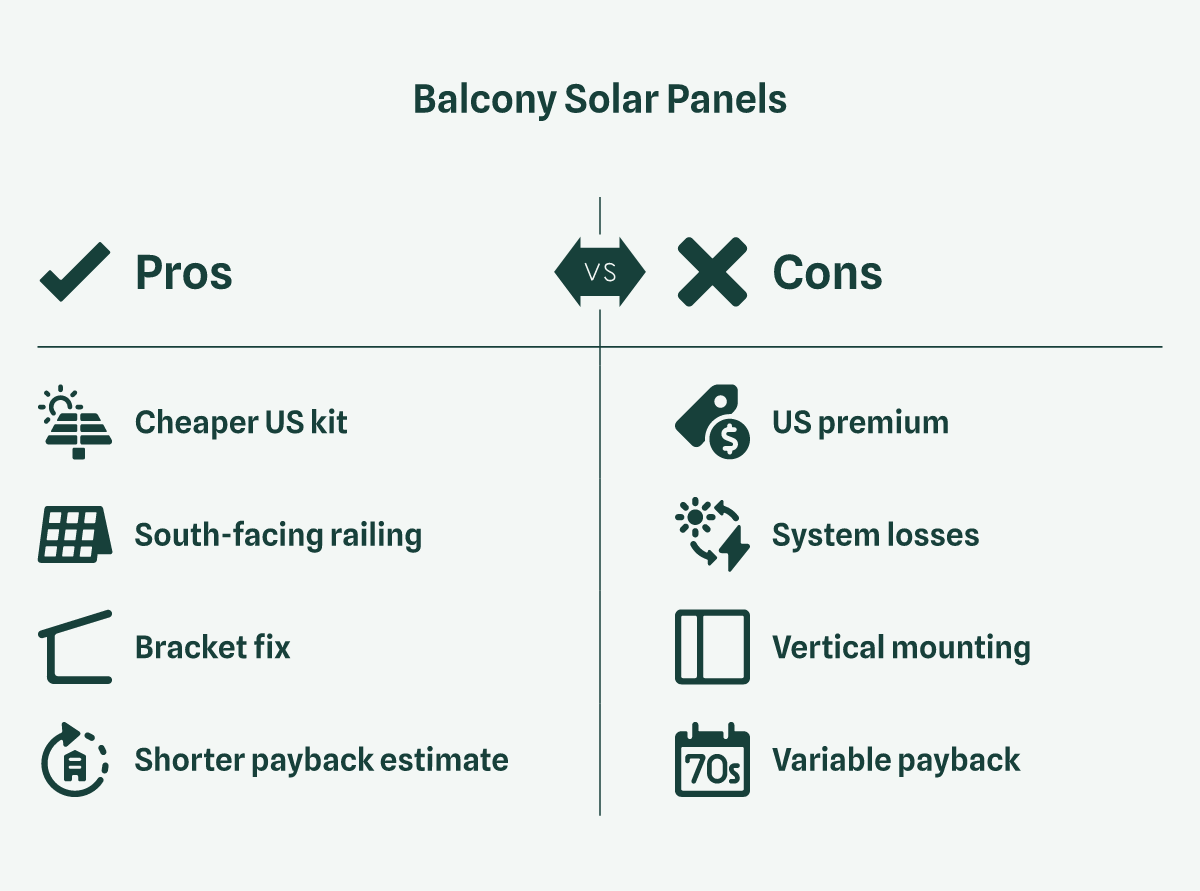
A US plug-in kit is cheaper than a rooftop system, but it's not the bargain Europeans get, and US buyers pay a premium for an embryonic market.
The output math, and where it breaks
Use system wattage × peak sun hours × 85% system efficiency. Solax's planning assumption is 3–4.5 peak sun hours per day and 15% total system loss. An 800W system at four peak sun hours gives about 2.72 kWh daily: 0.8 kW × 4 hours × 85% = 2.72 kWh.
I'd treat any higher number on a box as marketing until you know your mounting angle. Clamp a panel flat to a railing and it sits at roughly 90° to the ground. Frame-mount it and you're at roughly 30–35°. WattNest estimates that vertical-versus-framed gap costs around a third of annual output before orientation even enters it.
Orientation changes everything
WattNest's own estimates for two 450 W panels behind an 800 W inverter, at 70% use:
Face north and the frame gets you to roughly what a south-facing railing earns anyway. That's the cheapest fix available, and I'd spend on the bracket before a bigger panel.
Payback honesty
For an 800 W system, CESA puts payback at 4 to 13 years depending on equipment cost, electricity rates and production. Brightsaver estimates 2 to 7 years. Anyone quoting a single payback number is guessing at your orientation.
What the box doesn't tell you, rules, cladding, and the fine print
The fire-safety line that disqualifies flats
The UK's interim product specification requires manufacturers to warn prominently that a plug-in solar device must not be installed on aluminium composite material (ACM), metal composite material (MCM) or high-pressure laminate (HPL) cladding, timber cladding systems, timber balconies, or buildings subject to external wall remediation works. Read that last one again if your block has had a cladding survey or is waiting for one. This isn't a soft recommendation and it's not about your electrics. A large minority of flats that look like the natural market for balcony kits are ruled out by the building they sit in, not by the panel.
Registration isn't permission
In the UK the short version is 800 W AC maximum, up to 2,000 W of panels behind it, one device per household, and you notify your distribution network operator within 28 days rather than asking permission first. That word "notify" is doing a lot of work. In the US, California is considering SB 868, which would exempt qualifying portable solar devices from interconnection requirements, but that is still a bill, not a nationwide standard.
Panel wattage on the box isn't system output
An inverter rated at 800 W of AC output can be fed by more than 800 W of DC solar capacity. So the panel wattage printed on the carton isn't the number your circuit sees. US state legislation limits "portable solar generation devices" to 1200 W or less, and Germany caps balcony systems at 800 W of AC output.
If your building is excluded, the panel-only route is what is left.
FAQ
Can I use solar power in an apartment?
Yes, but only in two configurations. You can charge a portable power station from a folding panel on a balcony or windowsill, which feeds nothing into the building wiring. Or you can run a plug-in system through a regular outlet, which the Clean Energy States Alliance describes as "connected through a regular 120 V outlet into one of the circuits." The second route depends on state law and your lease. For the hardware side, see Portable Solar Panels for Your Home: Backup Power Without a Roof Install. The limit is the lease and the fire rules, not the panel.
Where can I buy portable solar?
In the US, from a small number of specialist sellers. That gap is the whole story. If you are in the US, expect a thin market and shipping that adds to the bill. My advice is to buy the panel and battery from one seller so compatibility is their problem, not yours.
What is the 120 rule for solar panels?
There is no standard "120 rule." The number 120 in this context usually means 120 volts, the US household voltage. CESA states that "standard household electricity in the United States is 120 V, while large appliances like HVAC, ovens, and water heaters may require 240 V." If someone quoted you a 120 rule for panel sizing, ask them for the source. The real limits are written in state law: CESA reports that US state legislation caps "portable solar generation devices" at 1200 W or less. Don't plan around a rule nobody can cite.
How long will a 200W solar panel run a fridge?
I can't give you a runtime, because no source here tests a 200W panel against a fridge. The nearest figure is a system four times that size. CESA says a two-panel, 800 W system paired with a 1 or 2 kWh battery "could power a refrigerator and a CPAP machine for 24 hours." Scale that down and a 200W panel won't carry a fridge through a day on its own.
Are folding portable solar panels worth prioritizing?
Only if you move them. Folding panels win on portability, not output per pound spent. That is roughly a third lost to mounting angle alone. If your panel stays on one balcony, I would skip folding and buy rigid. If it travels, see Lightest Portable Solar Panels for Backpacking and Travel.